Role: Co-PI and UI/UX designer, Design Director
Year: 2022- 2024
Funded by UConn SFA STEAM Innovation Grant
Collaborator: Dr. Christina Ross, assistant professor of nursing at the University of Connecticut
The project is under development by the UCONN DX group.
Project Contributors: Maria Shurupova(game), Nicole Mata(animation), Roya Movahed(UI/UX)
Black female adolescents face a greater risk of sexually transmitted infections and unintended pregnancies, being 4.5 times more likely to get Chlamydia and twice as likely to have unplanned pregnancies. Sadly, there are not enough programs tailored to their unique needs. Mobile health apps can help by giving these girls private access to important sexual and reproductive health information.
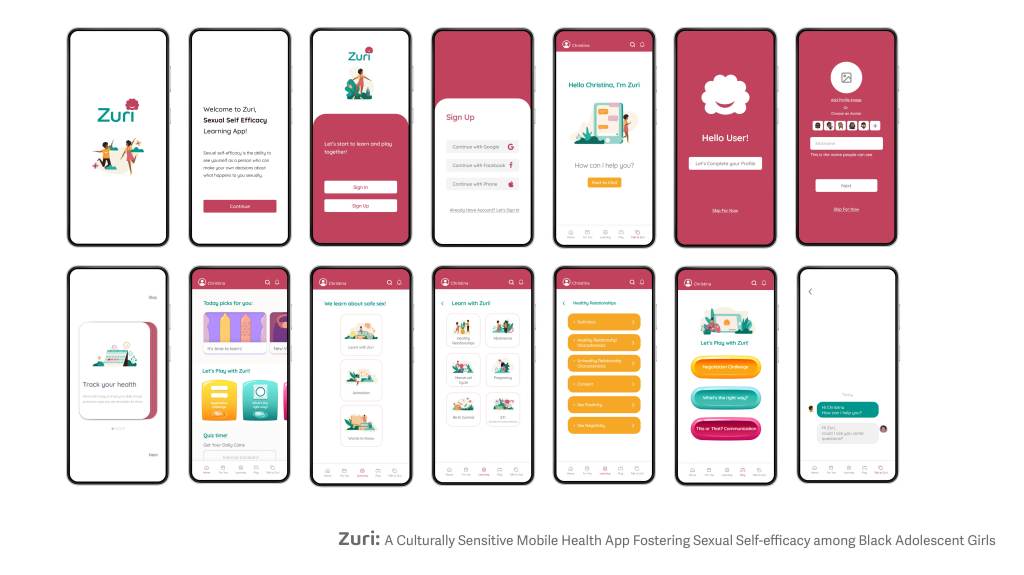
The Zuri application was created with the purpose of providing a culturally competent and representative resource for young black girls in foster care. In order to provide this, the animation of Zuri was developed to embody a character in which the target audience could relate. The pictures incorporated in the application were purposefully selected for the target audience to see representation while learning about women’s health. The Zuri application contains six educational modules with the goal of providing adolescent girls in foster care with foundational knowledge about women’s health. Young girls in foster care are regarded as a vulnerable population due to a multitude of factors such as lack of access to resources and patient-centered care. Our six modules highlight key concepts that are vital for success. The themes of the modules include Healthy Relationships, Menstrual Cycles, Abstinence, Birth Control, Sexually Transmitted Infections, and Pregnancy.
The app was designed with the intent of providing user-friendly text to the target audience, adolescent foster girls. The choice of word selection was completed with the purpose of representing a middle schooler’s level of English comprehension. Reproductive and Gynecological Health is an extensive topic, but text simplification was necessary for youth to understand. Another component incorporated into the app was the implementation of video animations for supplemental understanding. We recognize that individuals learn in multiple ways. Therefore, several voice and picture animations were created explaining important topics such as what to expect during the first visit with an OBGYN.

 Ting Zhou >> mHealth Design Lab